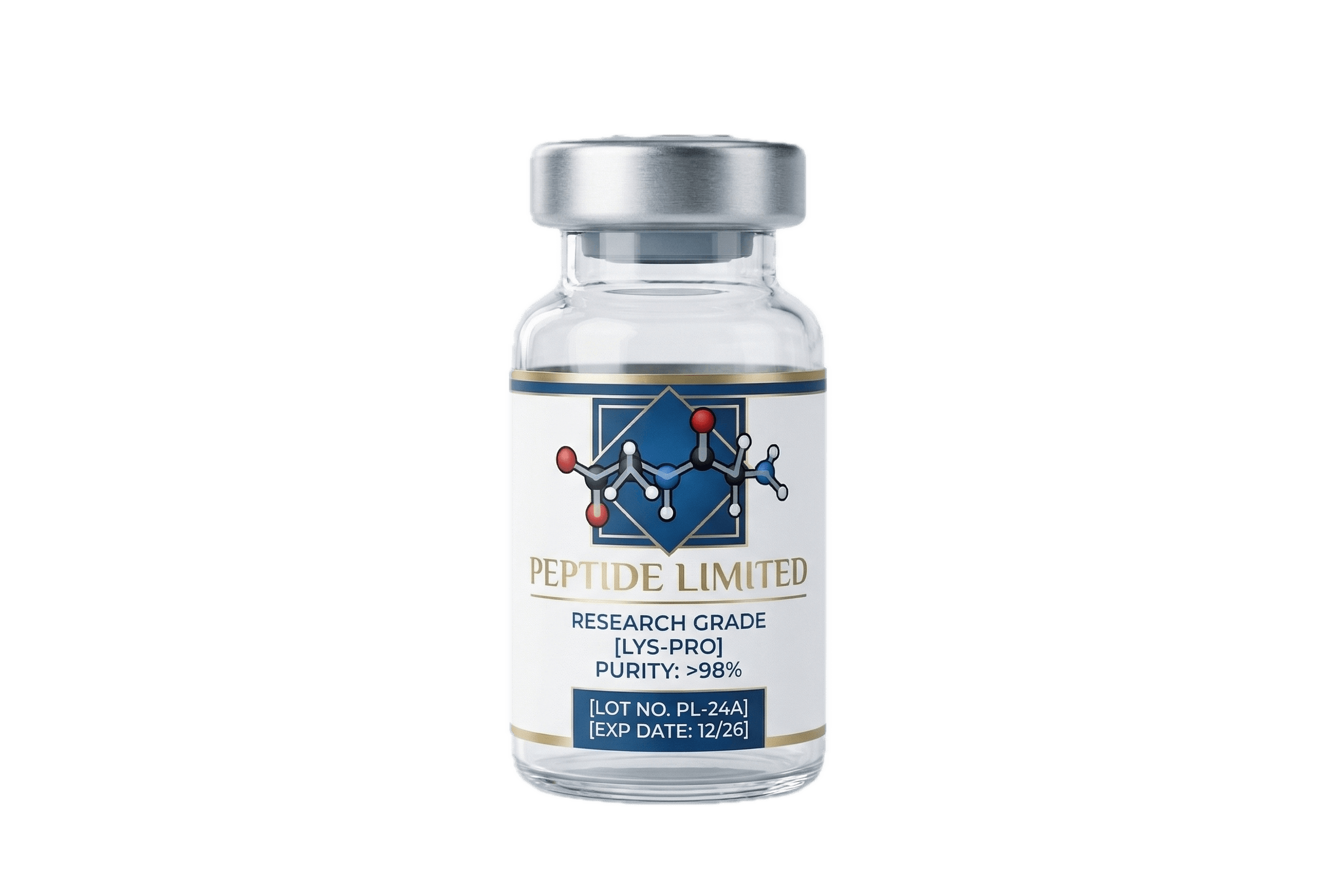
KPV (10mg)
Spécifications techniques
| Pureté (HPLC) | ≥98% (HPLC) |
| Numéro CAS | 67727-97-3 |
| Forme | White lyophilized powder |
| Stockage | -20°C |
| Séquence | Lys-Pro-Val |
| Poids moléculaire | 342.43 g/mol |
| Forme saline | Acetate |
| Solubilité | Soluble in water |
KPV (10mg)
Prix catalogue EUR · HU, SK, CZ, PL
- Eurozone (EUR)87,00 EUR
- Hongrie (HU)87,00 EUR≈ 34 800 Ft
- Slovaquie (SK)87,00 EUR
- Tchéquie (CZ)87,00 EUR≈ 2 175 Kč
- Pologne (PL)87,00 EUR≈ 369,75 zł
Même prix catalogue en EUR pour livraison vers la Hongrie, la Slovaquie, la République tchèque et la Pologne. Paiement en EUR.
Montants HUF/CZK/PLN indicatifs convertis depuis l’EUR ; la Slovaquie utilise l’EUR. Taux approximatifs. Paiement en EUR.
Alpha-MSH C-terminal tripeptide for inflammation research.
Mechanism: Inhibits NF-κB, reduces TNF-α/IL-1β/IL-6, penetrates cell membranes.
Applications: IBD models, wound healing, gut-immune research.
Note: No pigmentation effects unlike full α-MSH.
Strictement réservé à la recherche en laboratoire.
Non destiné à la consommation humaine, vétérinaire ou au diagnostic.
From the Peptide Explorer
A tripeptide derived from the C-terminal end of alpha-MSH. Unlike the parent molecule, KPV lacks melanocortin receptor binding but retains potent anti-inflammatory signaling, making it a focus of GI and dermatological research.
Key Mechanisms
- ›NF-κB inhibition (independent of MC receptors)
- ›Intracellular PEP-T1 transporter uptake
- ›Inflammatory cytokine suppression (TNF-α, IL-6, IL-1β)
- ›Direct antimicrobial activity
Primary Research Areas
- ›Inflammatory bowel conditions
- ›Dermatitis
- ›Antimicrobial defense
- ›Mucosal healing
Key Research Findings
- Reduced colonic inflammation in DSS-colitis mouse model (Dalmasso et al., 2008)
- Exhibited direct antimicrobial activity against S. aureus and C. albicans
- Transported into intestinal epithelial cells via PEP-T1 transporter
Research Overview
A tripeptide derived from the C-terminal end of alpha-MSH. Unlike the parent molecule, KPV lacks melanocortin receptor binding but retains potent anti-inflammatory signaling, making it a focus of GI and dermatological research.
Origin: C-terminal fragment of alpha-melanocyte-stimulating hormone (α-MSH)
Mechanism of Action
- NF-κB inhibition (independent of MC receptors)
- Intracellular PEP-T1 transporter uptake
- Inflammatory cytokine suppression (TNF-α, IL-6, IL-1β)
- Direct antimicrobial activity
Primary Research Areas
- Inflammatory bowel conditions
- Dermatitis
- Antimicrobial defense
- Mucosal healing
Key Published Findings
- Reduced colonic inflammation in DSS-colitis mouse model (Dalmasso et al., 2008)
- Exhibited direct antimicrobial activity against S. aureus and C. albicans
- Transported into intestinal epithelial cells via PEP-T1 transporter
Research Protocol
Commonly studied routes: Oral, Topical, Subcutaneous. Reconstitute with bacteriostatic water. Consult published literature for dose ranges; use our Peptide Calculator for volumetric preparation.
Storage
-20°C lyophilized, 2-8°C reconstituted
Important Notice
KPV (10mg) is supplied for laboratory research use only (RUO). Not for human or veterinary use, diagnostics, or therapeutics.
Spécifications de recherche
Synthesized for strict analytical consistency. Verified via HPLC/MS.Voir les standards qualité →
Manipulation et stockage
- Store lyophilized at -20°C
- Protect from light and moisture
- Use sterile bacteriostatic water for reconstitution
- Minimize freeze-thaw cycles
- Solubility: Soluble in water
Questions fréquentes
What is KPV (10mg)?▼
Is KPV (10mg) intended for human consumption?▼
How do you verify purity and identity?▼
How should KPV (10mg) be stored?▼
Do you provide a Certificate of Analysis (COA)?▼
What purity is KPV (10mg)?▼
Verified Research Reviews
Fani
"best product for inflammation "