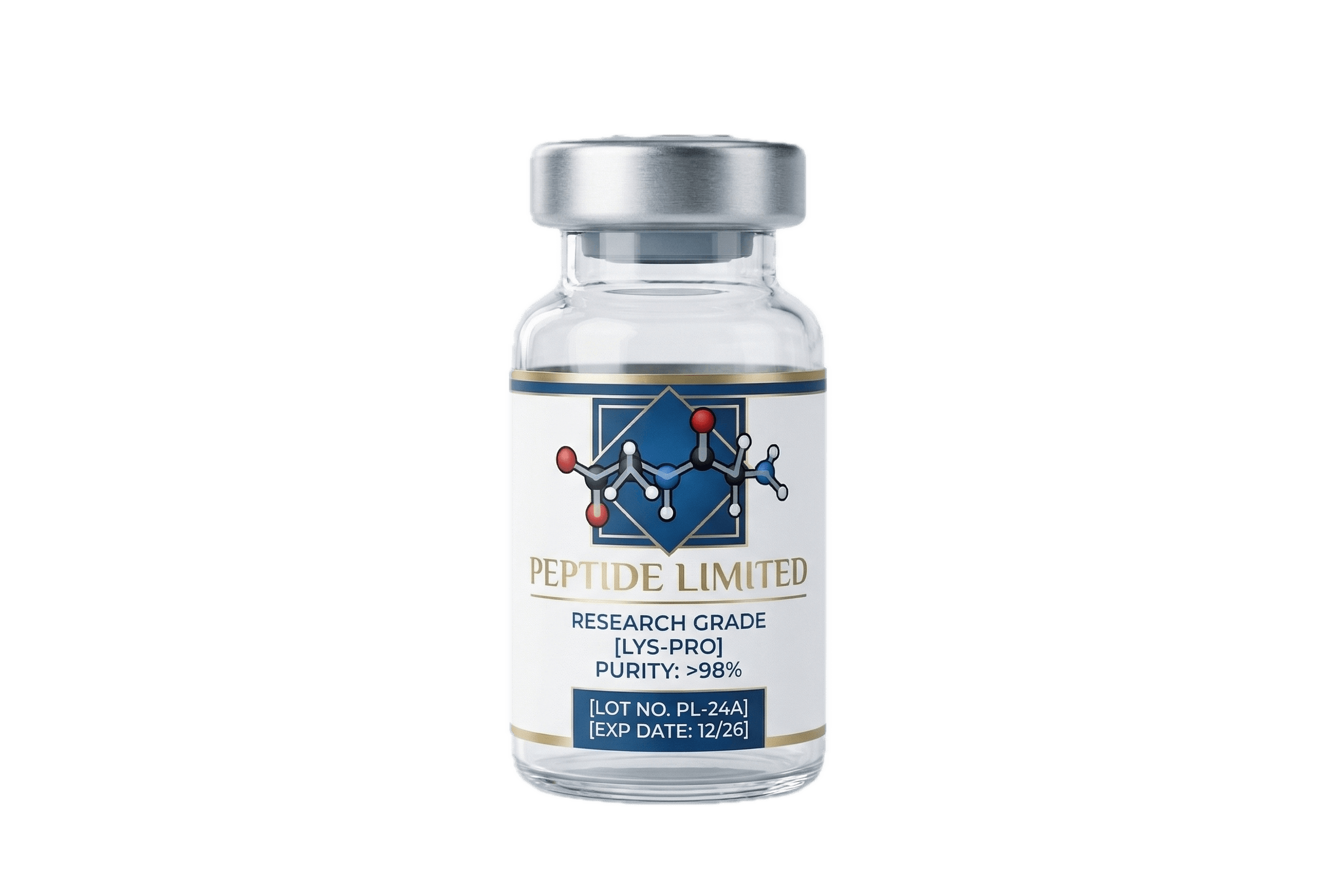
KPV (10mg)
Műszaki specifikációk
| Tisztaság (HPLC) | ≥98% (HPLC) |
| CAS szám | 67727-97-3 |
| Forma | White lyophilized powder |
| Tárolás | -20°C |
| Szekvencia | Lys-Pro-Val |
| Molekulatömeg | 342.43 g/mol |
| Sóforma | Acetate |
| Oldhatóság | Soluble in water |
KPV (10mg)
EUR listaár · HU, SK, CZ, PL
- Eurozone (EUR)87,00 EUR
- Magyarország (HU)87,00 EUR≈ 34 800 Ft
- Szlovákia (SK)87,00 EUR
- Csehország (CZ)87,00 EUR≈ 2 175 Kč
- Lengyelország (PL)87,00 EUR≈ 369,75 zł
Ugyanaz az EUR listaár a szállítás esetén Magyarországra, Szlovákiába, Csehországba és Lengyelországba. Fizetés EUR-ban.
A HUF/CZK/PLN összegek tájékoztató jellegűek (EUR-ból átszámítva); Szlovákia az eurót használja. Árfolyamok közelítők. Fizetés EUR-ban.
Alpha-MSH C-terminal tripeptide for inflammation research.
Mechanism: Inhibits NF-κB, reduces TNF-α/IL-1β/IL-6, penetrates cell membranes.
Applications: IBD models, wound healing, gut-immune research.
Note: No pigmentation effects unlike full α-MSH.
Kizárólag laboratóriumi kutatásra.
Nem emberi fogyasztásra, állatorvosi vagy diagnosztikai felhasználásra.
From the Peptide Explorer
A tripeptide derived from the C-terminal end of alpha-MSH. Unlike the parent molecule, KPV lacks melanocortin receptor binding but retains potent anti-inflammatory signaling, making it a focus of GI and dermatological research.
Key Mechanisms
- ›NF-κB inhibition (independent of MC receptors)
- ›Intracellular PEP-T1 transporter uptake
- ›Inflammatory cytokine suppression (TNF-α, IL-6, IL-1β)
- ›Direct antimicrobial activity
Primary Research Areas
- ›Inflammatory bowel conditions
- ›Dermatitis
- ›Antimicrobial defense
- ›Mucosal healing
Key Research Findings
- Reduced colonic inflammation in DSS-colitis mouse model (Dalmasso et al., 2008)
- Exhibited direct antimicrobial activity against S. aureus and C. albicans
- Transported into intestinal epithelial cells via PEP-T1 transporter
Research Overview
A tripeptide derived from the C-terminal end of alpha-MSH. Unlike the parent molecule, KPV lacks melanocortin receptor binding but retains potent anti-inflammatory signaling, making it a focus of GI and dermatological research.
Origin: C-terminal fragment of alpha-melanocyte-stimulating hormone (α-MSH)
Mechanism of Action
- NF-κB inhibition (independent of MC receptors)
- Intracellular PEP-T1 transporter uptake
- Inflammatory cytokine suppression (TNF-α, IL-6, IL-1β)
- Direct antimicrobial activity
Primary Research Areas
- Inflammatory bowel conditions
- Dermatitis
- Antimicrobial defense
- Mucosal healing
Key Published Findings
- Reduced colonic inflammation in DSS-colitis mouse model (Dalmasso et al., 2008)
- Exhibited direct antimicrobial activity against S. aureus and C. albicans
- Transported into intestinal epithelial cells via PEP-T1 transporter
Research Protocol
Commonly studied routes: Oral, Topical, Subcutaneous. Reconstitute with bacteriostatic water. Consult published literature for dose ranges; use our Peptide Calculator for volumetric preparation.
Storage
-20°C lyophilized, 2-8°C reconstituted
Important Notice
KPV (10mg) is supplied for laboratory research use only (RUO). Not for human or veterinary use, diagnostics, or therapeutics.
Kutatási specifikációk
Synthesized for strict analytical consistency. Verified via HPLC/MS.Minőségi standardok megtekintése →
Kezelés és tárolás
- Store lyophilized at -20°C
- Protect from light and moisture
- Use sterile bacteriostatic water for reconstitution
- Minimize freeze-thaw cycles
- Solubility: Soluble in water
Gyakori kérdések
What is KPV (10mg)?▼
Is KPV (10mg) intended for human consumption?▼
How do you verify purity and identity?▼
How should KPV (10mg) be stored?▼
Do you provide a Certificate of Analysis (COA)?▼
What purity is KPV (10mg)?▼
Verified Research Reviews
Fani
"best product for inflammation "