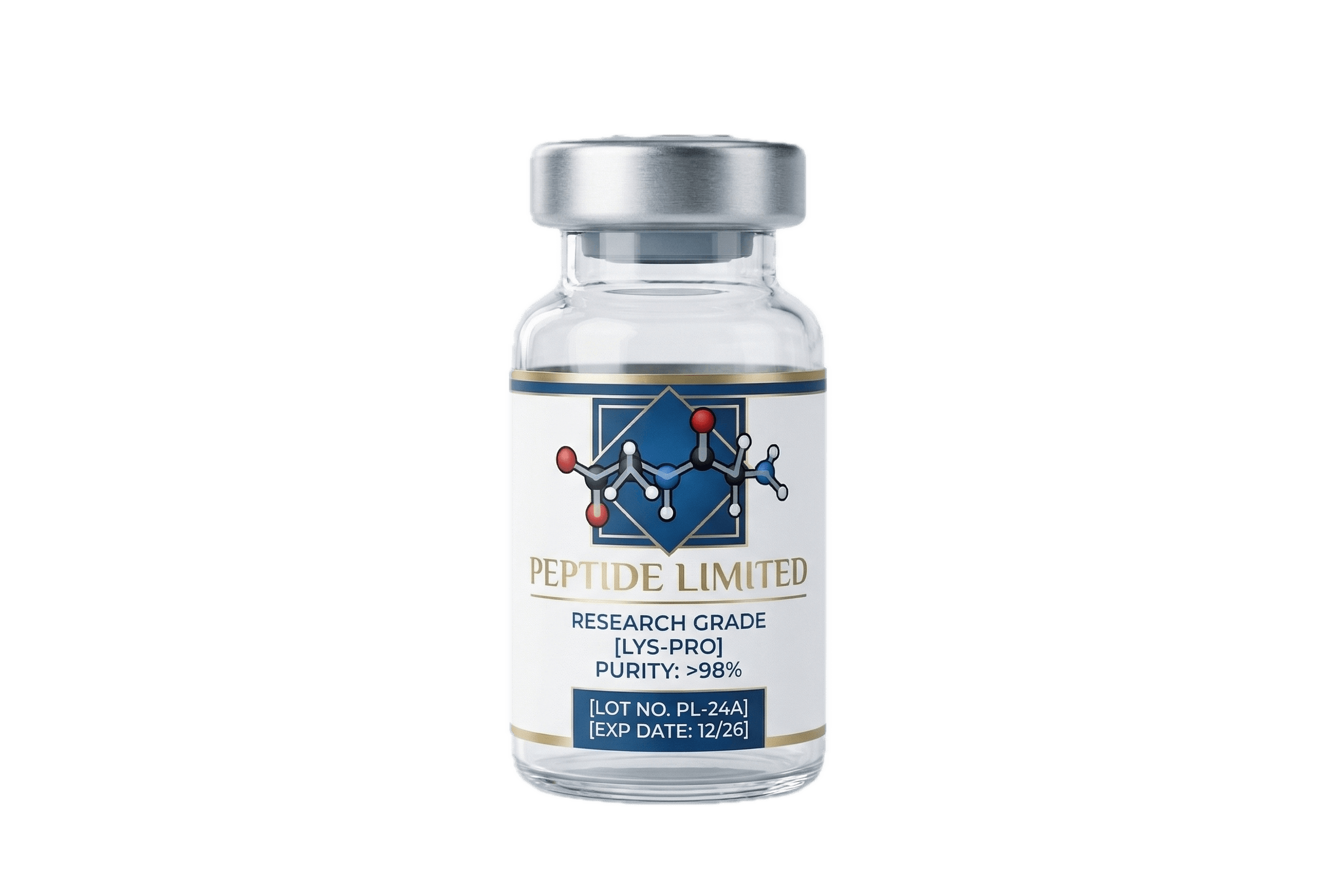
VIP (5mg)
Technische Spezifikationen
| Reinheit (HPLC) | ≥95% (HPLC) |
| CAS-Nummer | 37221-79-7 |
| Form | White lyophilized powder |
| Lagerung | -20°C |
| Sequenz | His-Ser-Asp-Ala-Val-Phe-Thr-Asp-Asn-Tyr-Thr-Arg-Leu-Arg-Lys-Gln-Met-Ala-Val-Lys-Lys-Tyr-Leu-Asn-Ser-Ile-Leu-Asn-NH₂ |
| Molekulargewicht | 3,326.82 g/mol |
| Salzform | Acetate |
| Löslichkeit | Soluble in water |
VIP (5mg)
EUR-Listenpreis · HU, SK, CZ, PL
- Eurozone (EUR)72,00 EUR
- Ungarn (HU)72,00 EUR≈ 28 800 Ft
- Slowakei (SK)72,00 EUR
- Tschechien (CZ)72,00 EUR≈ 1 800 Kč
- Polen (PL)72,00 EUR≈ 306,00 zł
Gleicher EUR-Listenpreis für Lieferung nach Ungarn, Slowakei, Tschechien und Polen. Abrechnung in EUR.
HUF/CZK/PLN sind indikativ aus EUR umgerechnet; die Slowakei nutzt EUR. Kurse annähernd. Abrechnung in EUR.
VIP (Vasoactive Intestinal Peptide) — 28-amminosäurisches Neuropeptid mit VPAC1/VPAC2-Rezeptoren; in Modellen zu Immunmodulation, Entzündung und zirkadianem Rhythmus. Nur RUO — ausschließlich für Laborforschung; nicht zum menschlichen Verzehr.
Ausschließlich für Laborforschung.
Nicht für den menschlichen Verzehr, tierärztliche oder diagnostische Zwecke.
From the Peptide Explorer
A 28-amino-acid neuropeptide found throughout the central and peripheral nervous systems, GI tract, and immune cells. VIP acts on VPAC1 and VPAC2 receptors to mediate vasodilation, smooth muscle relaxation, immune regulation, and neuroprotection across multiple organ systems.
Key Mechanisms
- ›VPAC1/VPAC2 receptor agonism
- ›Vasodilation via cAMP
- ›Anti-inflammatory cytokine regulation
- ›Neuroprotective signaling
- ›Smooth muscle relaxation
Primary Research Areas
- ›Neuroprotection
- ›Autoimmune disease
- ›Lung protection
- ›GI motility
- ›Vasodilation
Key Research Findings
- Demonstrated neuroprotective effects in Parkinson's and Alzheimer's models
- Aviptadil (synthetic VIP) advanced to clinical trials for ARDS
- Potent anti-inflammatory effects in autoimmune disease models
Research Overview
A 28-amino-acid neuropeptide found throughout the central and peripheral nervous systems, GI tract, and immune cells. VIP acts on VPAC1 and VPAC2 receptors to mediate vasodilation, smooth muscle relaxation, immune regulation, and neuroprotection across multiple organ systems.
Origin: Discovered in porcine intestinal extracts by Said & Mutt, 1970
Mechanism of Action
- VPAC1/VPAC2 receptor agonism
- Vasodilation via cAMP
- Anti-inflammatory cytokine regulation
- Neuroprotective signaling
- Smooth muscle relaxation
Primary Research Areas
- Neuroprotection
- Autoimmune disease
- Lung protection
- GI motility
- Vasodilation
Key Published Findings
- Demonstrated neuroprotective effects in Parkinson's and Alzheimer's models
- Aviptadil (synthetic VIP) advanced to clinical trials for ARDS
- Potent anti-inflammatory effects in autoimmune disease models
Research Protocol
Commonly studied routes: Intravenous, Subcutaneous, Intranasal. Reconstitute with bacteriostatic water. Consult published literature for dose ranges; use our Peptide Calculator for volumetric preparation.
Storage
-20°C lyophilized
Important Notice
VIP (5mg) is supplied for laboratory research use only (RUO). Not for human or veterinary use, diagnostics, or therapeutics.
Forschungsspezifikationen
Synthesized for strict analytical consistency. Verified via HPLC/MS.Qualitätsstandards ansehen →
Handhabung & Lagerung
- Store lyophilized at -20°C
- Protect from light and moisture
- Use sterile bacteriostatic water for reconstitution
- Minimize freeze-thaw cycles
- Solubility: Soluble in water